
Found in translation
The year of living incrementally

[H]e was a man of glass and not of flesh and bones, since glass, being a substance of more delicate subtlety, permits the soul to act with more promptitude and efficacy than it can be expected to do in the heavier body formed of mere earth.
—Miguel de Cervantes
The Catholic school I went to was not particularly hardline about Bible studies—they preferred Rugby—but we had a teacher in Year 12 who was a little obsessed with one particular passage, Mark 8:36, which reads in the King James version as: “For what shall it profit a man, if he shall gain the whole world, and lose his own soul?”
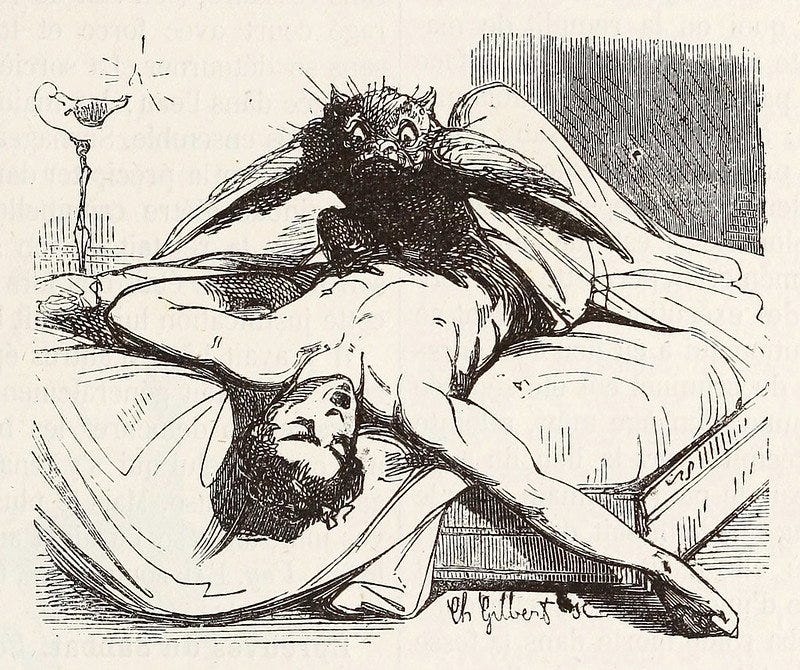
Like all good Bible verses, it is infinitely malleable, and the regularity with which it has been quoted over the centuries is testimony not just to the fact that it captures something essential about human nature, but that it doesn’t require a religious context in which to make its point. The word “soul” is flexible enough to cover everything from what Catholics understand by the concept, to more secular notions of self-worth, integrity and the transcendent.
What allows this variation to emerge is the fact that the Bible is translating the word “psyche”, a Greek word that captures ideas of life, spirit, breath, self as well as the soul. In fact, in Mark 8:35, the same word is translated as life, as in, “whoever loses their life for my sake will save it.” In short, the word psyche gifts us this range of expression, with meaning itself found in translation.
Mark 8:36 echoes through much of literature and philosophy, never more enduringly than in the legend of Dr Faustus. From Marlowe to Goethe, the story and its underlying notion of exchanging some spiritual essence for material reward, are told and retold. Marx read Faustus as an allegory for capitalist alienation. Thomas Mann turned the story into a study of Nazism, the sacrifice of humanity for racial purity and totalitarian power (though one wonders if Hitler, much less Trump, ever had a soul to exchange in the first place, or whether that absence had manifested much earlier in life).
My favourite mystical, Jewish-Catholic, heterodox-French socialist, Simone Weil, spent some time with the passage and it colours a lot of her thinking.1 In her amazing essay, “Human Personality”, she writes that “There is something sacred in every man, but it is not his person. Nor yet is it the human personality. It is this man ; no more and no less.” What always threatens to extinguish this essence, she argues, are forms of collective thinking, coercive social organisation, and, of course, political power. She writes:
Apart from the intelligence, the only human faculty which has an interest in public freedom of expression is that point in the heart which cries out against evil. But as it cannot express itself, freedom is of little use to it. What is first needed is a system of public education capable of providing it, so far as possible, with means of expression; and next, a regime in which the public freedom of expression is characterized not so much by freedom as by an attentive silence in which this faint and inept cry can make itself heard; and finally, institutions are needed of a sort which will, so far as possible, put power into the hands of men who are able and anxious to hear and understand it.
She wants institutional designs that reward attention to affliction—leaders whose primary qualification is their capacity and willingness to listen to injustice and respond justly, rather than their strength of will, charisma, or doctrinal clarity.
Ah, don’t we all?
Anyway, I was watching this clip of Anthony Albanese getting quite angry about the very idea of having a Royal Commission into violence against women, and I think you can see the exact moment his soul departs his body. The interviewer certainly recognises the moment, and her expression is everything.
I have documented any number of matters in these pages about what I don’t like about this Labor government, starting with its commitment to incrementalism and its backroom technocracy, along with its ongoing abandonment of the most worthwhile aspects of Labor tradition. Most of this is seated in the fact that the party has internalised belief in a market-based economy, such that nearly every “reform” is judged in terms of what the market can bear and provide.
But I don’t think I really saw what was happening until I watched this clip of how the prime minister responded to a perfectly reasonable question. The sense of annoyance that came through in his response, along with the condescending way he dismissed the idea of a Royal Commission, suggested another sort of change. Did he tell the people braying for an RC into the Bondi tragedy that it wasn’t worth it because the only people a RC helped were the lawyers? Yes, I realise he did actually reject that RC at first too, but not on these terms or with this attitude.
Apart from anything, it’s a bit rich for the guy who slow-tracked or ignored key recommendations from the Robodebt Royal Commission to be quite so dismissive of their efficacy. Economic Justice Australia CEO Kate Allingham welcomed some aspects of the government’s response but said in July 2025, “While the unlawful Robodebt scheme was a Liberal-era policy failure, the Labor Government has now been in power for three years. Anthony Albanese has previously called the Liberal Party’s failures in this regard a ‘gross betrayal’ of Australian citizens, but a full term in power failing to enact legislative reform also makes this Government culpable of failing to protect its constituency.”
Clearly, a political party busily seeking, or maintaining itself in power can discern nothing in these cries except a noise. Its reaction will be different according to whether the noise interferes with or contributes to that of its own propaganda. But it can never be capable of the tender and sensitive attention which is needed to understand its meaning. —Simone Weil
Am I the only person flabbergasted by this clip of the PM?
I have no interest in holding any politician to an impossible standard, but I would certainly like to raise our expectations. I would like a politician who trades on the Labor tradition in the way our prime minister does to recognise that he is part of a broader progressive movement that deserves respect and consideration. Albanese not only does not do this, he actively uses that movement as a foil against which he seeks to establish his credentials as a “serious” politician.
His dismissal of a Royal Commission into violence against women was a particularly egregious example of that tendency, and it came off as something like contempt.
But there are other examples, too, and taken by themselves, you might accuse me of being oversensitive, but there are just too many instances where the PM’s instinct is to get annoyed with those on his side of the political ledger for it to be a coincidence. Certainly, he is driven by an understandable desire to install Labor as the dominant political party in the land, but that merely points to the problem with party politics, in that it puts the interests of the party ahead of those of the country, sacrificing long-term solidarity for short-term party gain.
The most obvious example of what I’m talking about is the way the PM has sought to turn the Greens into a bogeyman. The Greens have long provided a reliable avalanche of preferences for Labor, but Albanese has made an art of dismissing them as “the Greens political party” and even as the “noalition”, conflating them with the Coalition if they dare to amend Labor legislation in the Senate. The hypocrisy of this—given the willingness of his government to negotiate with the Coalition when it suits them, as happened with campaign finance reform—is breathtaking. And annoying.
Another recent example was the PM singling out the Australia Institute over their stance on a tax on super profits on fossil fuel exports. Albanese publicly dismissed the Institute’s campaign as lacking credibility, while using the gas industry’s own accounting to rebut them. This isn’t just a difference of opinion over policy; it’s a conscious effort to establish a political identity: ridicule a progressive organisation in order to curry favour with capital.
Some more examples: In a private 2024 meeting with Jewish leaders, it was reported that Albanese described pro-Palestinian campus protesters as “Trots” looking to “instigate and make trouble”. This is at one with his attitude to the pro-Palestinian protesters outside his campaign office in Marrickville and on university campuses. He not only publicly dismissed them as ignorant people who “wouldn’t be able to find the Jordan on a map”; he went so far as to close the office itself, framing the protesters as a threat to civic life. He accused them of abusing those attending church nearby, though Reverend Ross Ciano, the minister at the neighbouring St Clement's Anglican Church, noted that one funeral service had been affected, “but it’s just been noise”. Ciano added, “We’ve also got people in our church who support the message [of the protesters]. We are a multicultural congregation who have different views and that’s what we think is a healthy congregation.”
The PM begs to differ, apparently.
Let’s not forget that the PM described himself in his first speech to parliament as a “democratic socialist”, so supporters are entitled to expect a certain level of simpatico from him—I mean, come on—but time after time he reacts with anger, annoyance and condescension to those from his end of the political spectrum. His response to Sean Kelly’s meticulously fair assessment in a recent Quarterly Essay is yet another example. He dismissed Kelly’s argument as “wrong” and said it “romanticises a mythical land that he lived in once”. This is not merely a disagreement with the essay’s discussion, it characterises progressivism itself as a form of nostalgia, and what are Labor supporters meant to make of that?
Compare his response to Kelly with the chatty away he responded to the misleading media campaign against the latest Budget, joking about them using some “flattering” photos of him in the memes. I understand the tactics of this, but there are just too many instances of him appeasing the Tories he once claimed to fight, while coming down hard on progressives and leftists.
As a tactic, it does long-term strategic damage to progressive politics, delegitimising criticism from the left while accepting as legitimate that from the right. It is an example of what an article in the Australian Journal of Political Science describes as “thin labourism”. The authors define this as a sort of “consensus politics” that is “primarily geared towards gaining the support of the business sector” and “constrained by the broader neoliberal framework under which it operates”. The analysis notes that “the ALP’s rhetoric of consensus [displays] unevenness, focusing more on industry and the business sector rather than trade unions or civil society groups”.
There is absolutely a devil’s bargain involved in such a shift and you can’t help but feel that, day by day, even as the PM gets everything he could ever want electorally, that that success plays out against an underlying discontent in which his scorched-earth approach to progressives, who were desperate for a Labor government to do well, has been squandered in pursuit of legitimacy from the other side of politics.
Maybe the way to understand this is to suggest that what looks like tactical genius inside the Prime Minister’s Office plays out within the broader progressive side of politics as an act of kenosis—a massive hollowing out—in which each little victory against the Greens, or the Australia Institute, or campus activists, or a mildly critical Quarterly Essay diminishes the moral and imaginative ecosystem that once gave Labor its meaning.
I genuinely (and foolishly) held out hope that Anthony Albanese would somehow take us on a path to a better nation. I believed his schtick about council housing and the struggles of his single mum and what it implied about his politics. What it was designed to imply. I took to heart his declaration that what he did was fight Tories. I honestly believed he might recognise in the narrowness of his 2022 victory and the changes in the electoral landscape that began consolidating at that time that he would seize the opportunity he had been handed to reinvent Australian politics into something much closer to the vision Weil articulates, where that human cry is heard. That he would at least acknowledge that people were looking for something better and were open to be taken into the confidence of leader whose life experience had instilled something particular in him.
Instead, he attacks friends while cosying up to enemies, and if you measure it terms of seats won, then the devil is keeping his side of the bargain. But it isn’t simply that Albanese has traded a bit of “left flank” noise for “centrist” approval: he has steadily shifted the ground under his own supporters such that he treats as “serious politics” only that which reassures capital and conservatives, while anything that speaks too much of justice, solidarity, historical memory, is dismissed as either naive, “Trots”, or merely nostalgic.
The prime minister is kidding himself if he thinks people on his (alleged) side of the aisle aren’t feeling this deeply—as a betrayal—and that interview about a Royal Commission into violence against women is perhaps the clearest moment we have yet had in which the Faustian bargain has shown itself.
We await the third act.
Oh gallop slowly, you horses of the night.
—Christopher Marlowe
UPDATE: Apologies, I got my notes muddled in that section about Albanese’s reaction to Sean Kelly. ‘The basic point still holds, but the quote is from a response AA made to an earlier piece Sean Kelly had written. In his most recent Quarterly Essay, Kelly writes: During the Albanese government’s first term, I wrote that it was hard to think of much that would be remembered. Almost half a year into the government’s second term, that hasn’t changed.
‘This is the 100th Quarterly Essay. In the ninety-sixth, published late last year, George Megalogenis made use of my rule of three. He put it to Albanese, asking him to react to “the observation that while his government has been busy, it is risk-averse and low-key.” Albanese, he wrote, “bristle[d]” at the suggestion. “He’s wrong,” he said. “He romanticises a mythical land that he lived in once.” In other words, I was holding his government to a false standard.’
Again, apologies.
n=1
Dear Albo,
No matter how much you suck up to Rupert, he's never going to pick you.
I just don’t get it.
Cosying up to an establishment that will dump him like a hot potato to make way for an LNP or even a ON if it gives capital a better rate of profit while simultaneously undermining the left? It’s madness.
From a political perspective, It’s applying short-termist thinking while claiming to take the long-term view. He may be chuckling at ALP dominance as a consequence of the clown show that is the LNP, but the fragmentation of the Right is a poisoned chalice.